

Verity analyst shares early patterns in how investors are using the VerityData MCP.
Three months ago, looking up a company’s recent insider activity, the state of its buyback program, or a specific topic in a 10-K meant logging into a platform, clicking through menus, exporting data, and stitching it together in a doc.
Today, investors are asking those questions in natural language and getting structured, sourced answers in seconds. The connective tissue is the Model Context Protocol (MCP), an open standard that lets AI assistants like Claude work directly with VerityData’s tools, calling them by name and pulling in structured data on the fly.
I’ve written earlier about how AI-native workflows are changing how investors think about data quality. Now, here are five workflows showing patterns we’re seeing across real customer usage in the first months since we launched the VerityData MCP.
The most common pattern. An investor doesn’t want a dashboard, they want a brief. They ask one open question, and Claude fans out across many MCP tools at once and returns a synthesized read.
In the example below, a single question about NVDA triggered six simultaneous tool calls covering insider transactions, 10b5-1 plans, buyback announcements, management events, and the latest 10-K.
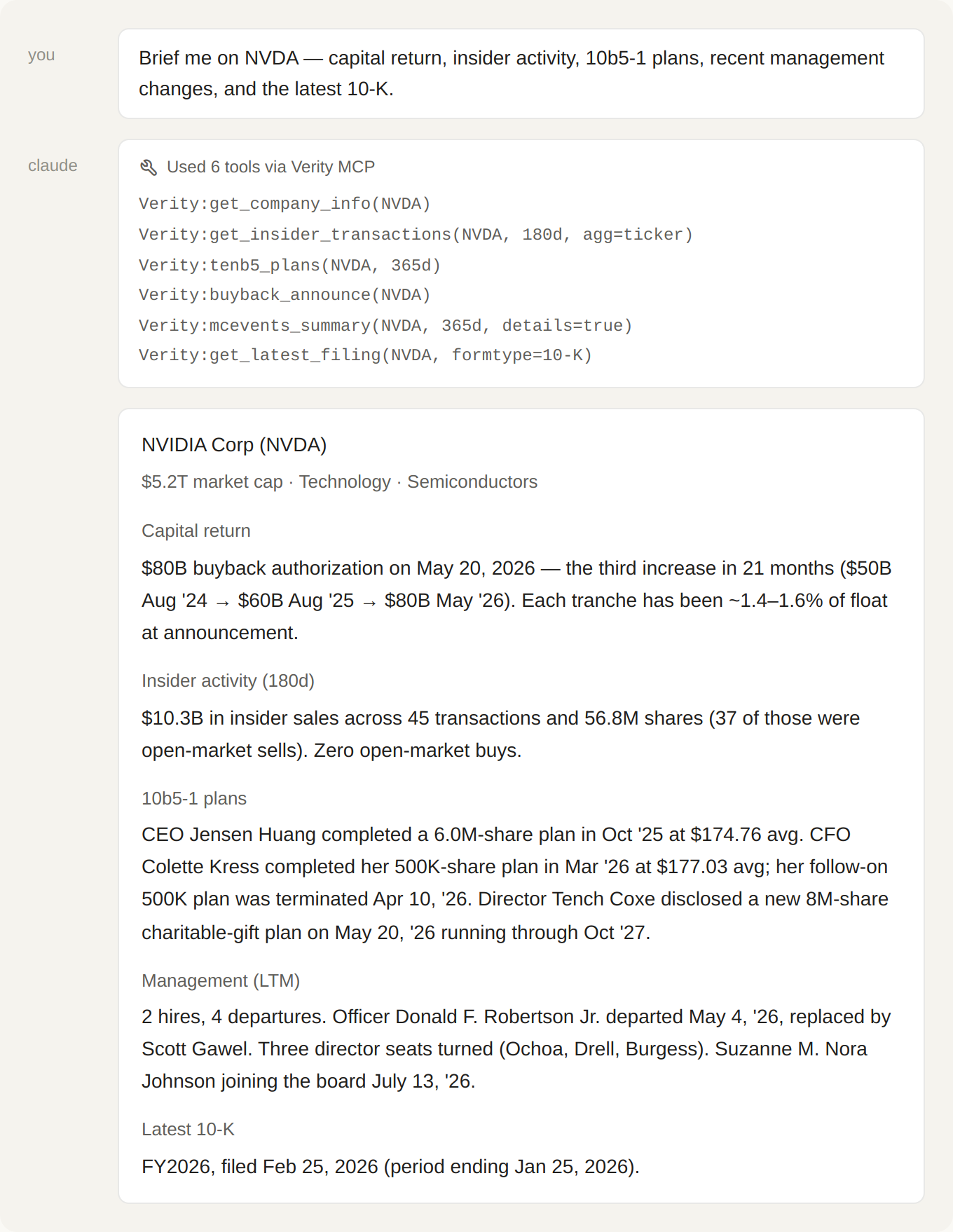
Claude pulls across insider activity, capital allocation, and filing events simultaneously and returns a synthesized read, not a list of raw data pulls.
What used to take an hour of clicking around a platform is now a 30-second conversation. Because Claude composes the tools dynamically, you get the cross-section of insider activity, capital allocation, 10b5-1 schedules, and board-level events woven into a single read rather than gathered separately.
A modern 10-K runs 80,000 words. Finding everywhere a company talks about tariffs, AI infrastructure, or supply-chain risk across recent filings used to mean Ctrl-F’ing through PDF after PDF. Now it’s one question.
In the example below, an analyst asks about PLTR’s commercial vs. government revenue split. Claude pulls the latest 10-K and returns a sourced summary with cited passages. The analyst then follows up (“And how did the Q1’26 call frame it?”) and Claude pulls the earnings transcript summary and connects it to the 10-K read, in the same thread, with no new setup required.
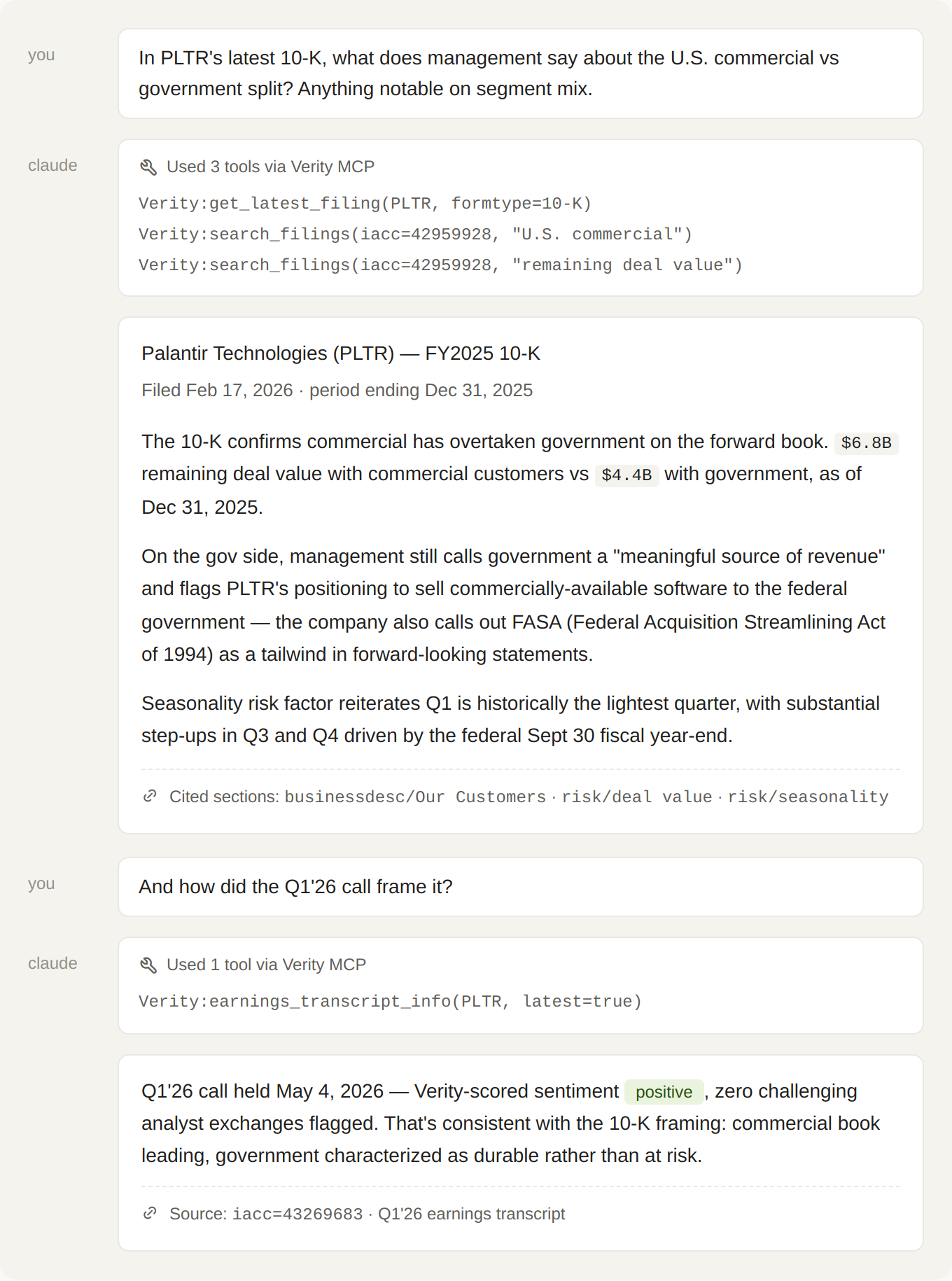
Results include the section context and surrounding snippet, not just the matching line, closer to how an analyst would actually read it.
The AI goes beyond keyword matching, pulling in section context, the snippet, and more. The analyst is reading the relevant content within seconds, not after a half-hour of searching.
Some of the most valuable data lives in niche corners: executive compensation plans, 10b5-1 trading arrangements, ATM offering programs, charitable gifts, board-level events. Serious investors care about these, but they’re scattered across Form 4s, 8-Ks, proxy statements, and S-3s. Assembling them by hand is grunt work.
In the example below, an analyst asks about MSTR’s ATM cadence, program-level changes, and whether insiders are trading alongside corporate issuance. Claude pulls four specialized datasets and surfaces a composite read. The bottom-line answer: issuance is concentrated at the corporate level, insiders are not riding the window.
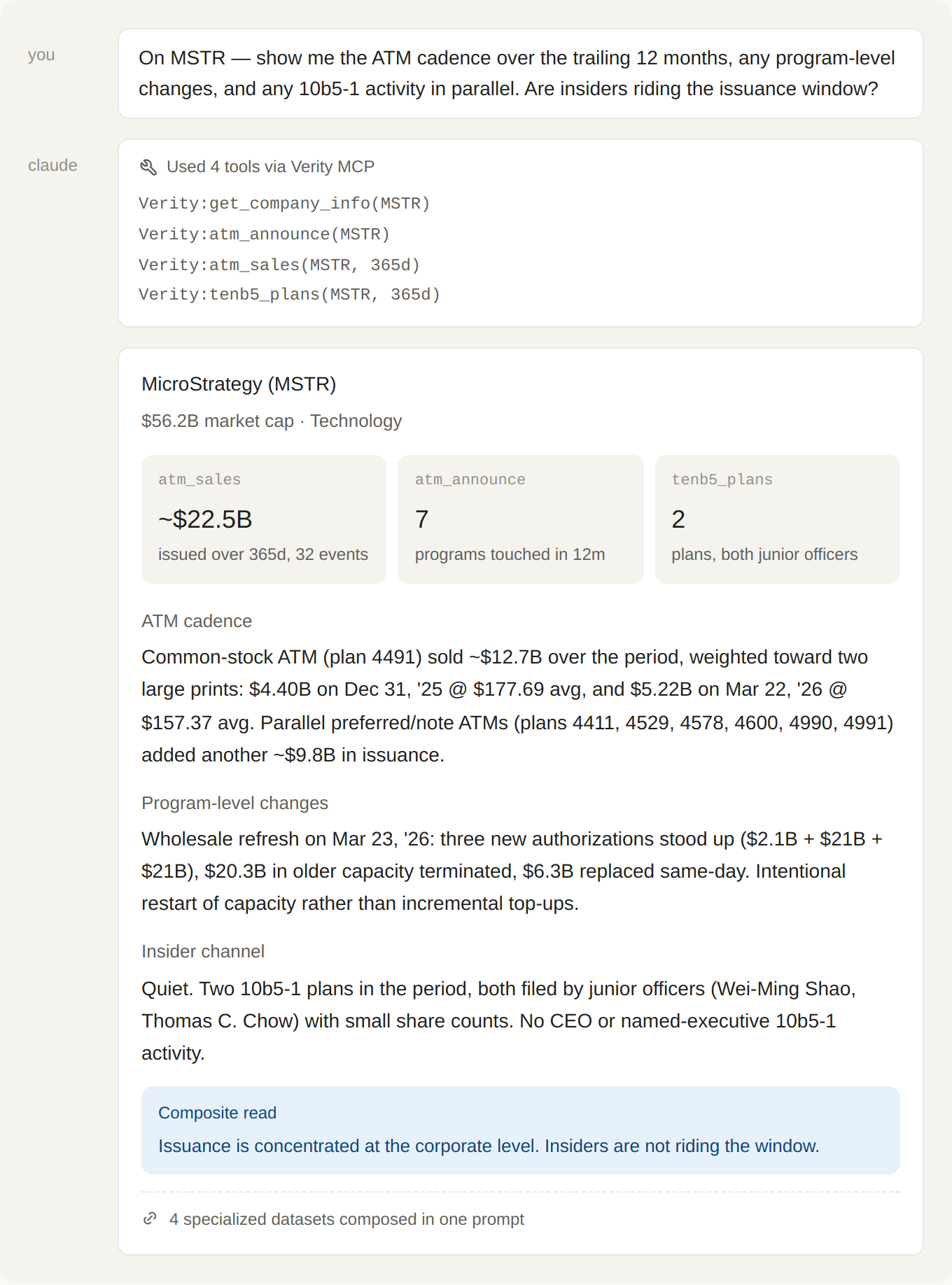
Four specialized datasets composed from one question. The composite read at the bottom connects them into a single conclusion: issuance is concentrated at the corporate level, insiders are not riding the window.
This is exactly the kind of detail that gets buried across multiple filings and is otherwise invisible unless you’re reading everything carefully. MCP makes it discoverable, and the AI knows enough to flag the right interpretation.
Related: Exploring 13F Filings in the VerityData MCP Server
Instead of monitoring a portfolio one name at a time, the analyst asks the AI to scan the whole list at once. The AI works with a thematic list of names or with your VerityData watchlist. In ten seconds the analyst knows where the action is. They can then drill into any one of those names with another question, and the AI already has the surrounding context from the same session.
In the example below, an analyst asks for insider activity across the megacap tech names over the last 30 days. Claude scans all six tickers and returns a ranked summary, including the observation that there were zero open-market buys across the entire group.
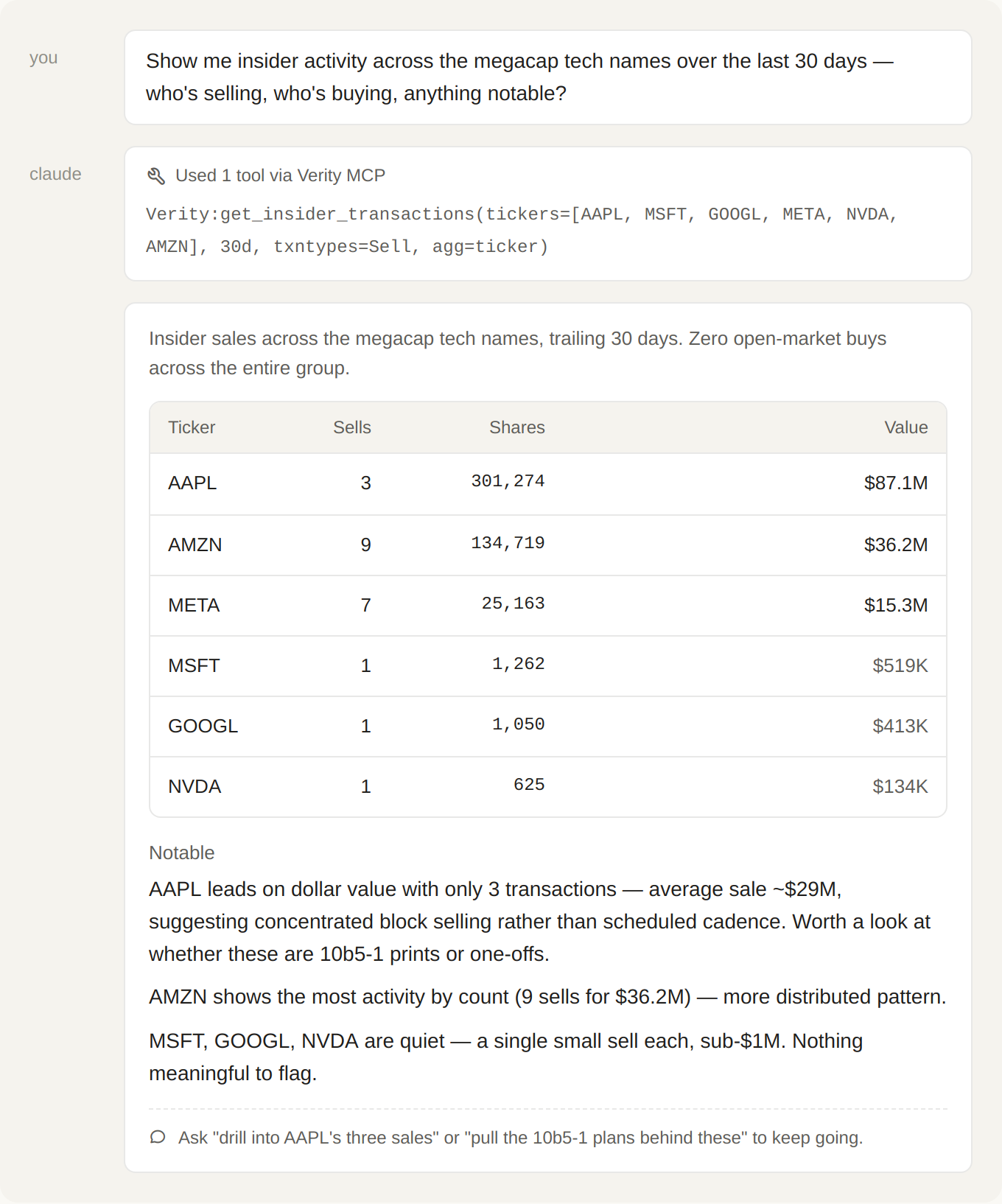
The AI scans the full watchlist and flags where there’s activity. The analyst drills into any name from the same session.
Peer comparisons used to mean assembling spreadsheets by hand. Now the AI does the assembly.
In the example below, an analyst asks Claude to compare Q1’26 buybacks across JPM, BAC, and WFC: dollars spent, average price, remaining authorization. The output includes derived metrics that don’t appear in any single filing, including effective float-reduction ratio and lifetime average price. BAC’s 36.7% effective ratio means it has converted more of its cumulative buyback spend into actual float reduction than the other two, a finding that doesn’t surface from headline buyback dollars alone.
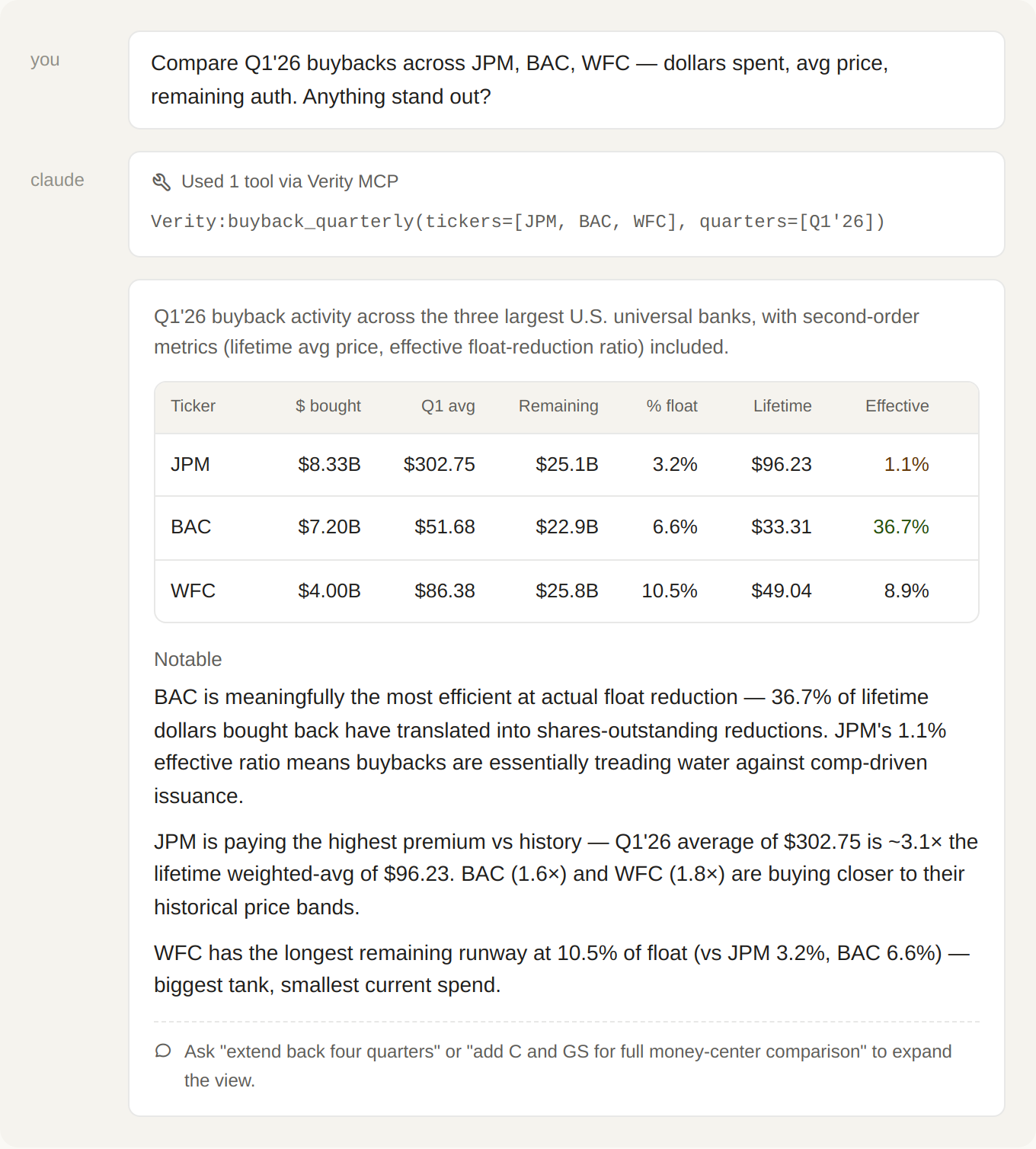
The comparison includes derived metrics alongside headline figures. BAC’s effective ratio of 36.7% is the kind of second-order observation you wouldn’t catch assembling this by hand.
The analyst can drill deeper on any line without reformatting anything.
These five patterns have one thing in common. The analyst asked one question and got a sourced, cross-dataset answer in seconds. It’s the kind of read that used to require pulling from multiple places and assembling by hand. That’s what the VerityData MCP is built for, and we’re seeing it used this way across hedge funds, long-only managers, multi-strategy shops, and quant teams from the first months of launch.
VerityData delivers structured, decision-ready data from SEC filings, insider transactions, institutional ownership, and more — built for the automated workflows investment teams are deploying today. Access 20+ years of the most accurate and complete data of its kind, plus 2,000+ annual research briefs from VerityData experts.

See how Verity accelerates winning investment decisions for the world's leading asset managers.
Request a Demo